
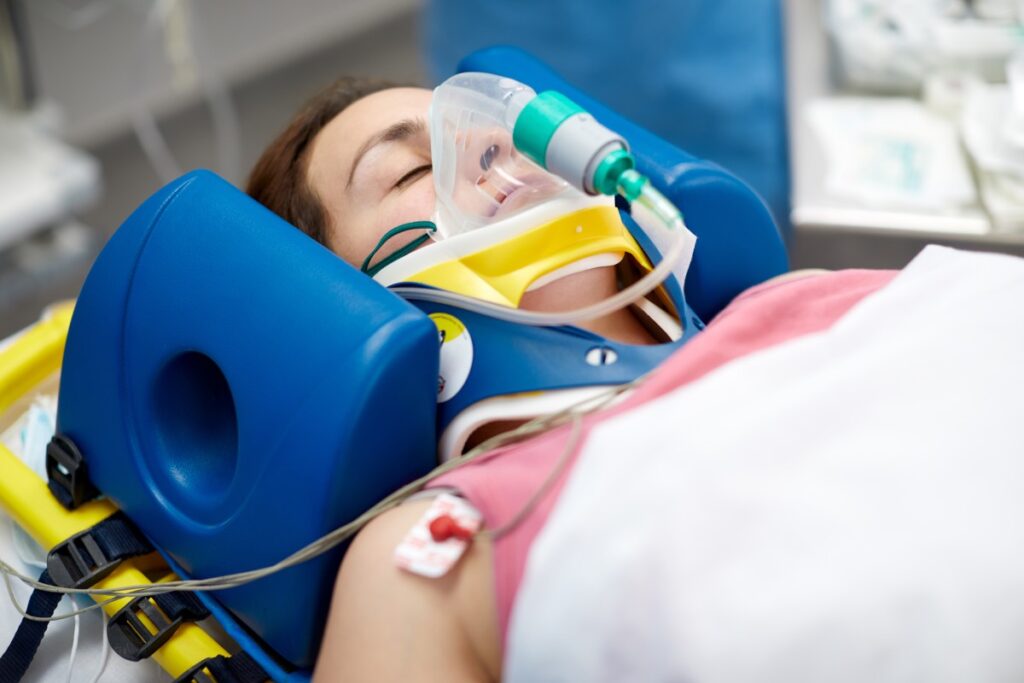
Cervical collar placement is a standard initial immobilization strategy for patients with suspected cervical spine injury, intended to maintain neutral alignment and reduce the risk of secondary neurologic damage. However, airway management in this context presents a significant clinical challenge. The need to secure a definitive airway must be balanced against the risk of exacerbating spinal injury through cervical movement and the risks associated with hypoxia during prolonged or difficult intubation. This is particularly relevant in cervical spine trauma because diaphragmatic function is primarily innervated by the C3–C5 spinal nerve roots; high cervical injuries may therefore impair spontaneous ventilation and necessitate emergent airway intervention. Consequently, intubation in patients wearing a cervical collar requires a high level of clinician skill.
A commonly used approach to optimize laryngoscopic view in routine airway management is the “sniffing position,” which aligns the oral, pharyngeal, and laryngeal axes through flexion of the lower cervical spine and extension at the atlanto-occipital joint. In patients with suspected cervical spine injury, this positioning is avoided to minimize potential spinal displacement. Instead, cervical immobilization is maintained in a neutral position, which may limit optimal airway axis alignment and can make laryngoscopy more challenging.
Cervical collars can further complicate airway management by restricting mandibular movement and limiting mouth opening, thereby reducing the effectiveness of direct laryngoscopy and potentially increasing intubation difficulty. For this reason, many protocols recommend temporary modification of immobilization during airway intervention.
A standard rapid sequence intubation (RSI) approach is generally recommended in these patients, alongside adjustment of the cervical collar for adequate jaw mobility. This includes adequate preoxygenation, administration of an induction agent followed by neuromuscular blockade to minimize airway reflexes and patient movement, and preparation for a potentially difficult airway. Prior to laryngoscopy, the anterior portion of the cervical collar is typically removed while maintaining manual in-line stabilization (MILS) to limit cervical spine motion (Austin et al., 2014). Preoxygenation is particularly important, as patients with high cervical injury may have reduced ventilatory reserve due to diaphragmatic impairment.
First-pass intubation success is critical, as multiple attempts are associated with increased hypoxia and worse outcomes. Apneic oxygenation via nasal cannula may be used to extend safe apnea time during induction. The 2022 American Society of Anesthesiologists (ASA) Practice Guidelines for Management of the Difficult Airway emphasize individualized, team-based decision-making, including consideration of awake intubation in selected patients with anticipated difficulty or limited physiologic reserve, alongside ensuring availability of skilled assistance and backup airway equipment (Apfelbaum et al., 2022).
Videolaryngoscopy is increasingly favored as an initial technique in patients with suspected cervical spine injury. Compared with direct laryngoscopy, it improves glottic visualization without requiring alignment of airway axes and has been shown in experimental models to reduce cervical spine movement during intubation (Votruba et al., 2020).
Overall, airway management in patients with suspected cervical spine injury requires balancing the prevention of secondary neurologic injury against the risks of hypoxia, which is a major contributor to morbidity and mortality. Current evidence supports a structured approach based on rapid sequence intubation, adjustment of the cervical collar with manual in-line stabilization, optimization of first-pass success, and early preparation for difficult airway scenarios. No single device or technique is universally superior; rather, outcomes depend on systematic preparation, adherence to airway algorithms, and effective contingency planning.
References
- Austin N., Krishnamoorthy V., Dagal A. Airway management in cervical spine injury. Int J Crit Illn Inj Sci. 2014;4(1):50-56. doi:10.4103/2229-5151.128013
- Apfelbaum JL., et al. 2022 American Society of Anesthesiologists Practice Guidelines for Management of the Difficult Airway. Anesthesiology. 2022;136(1):31-81. doi:10.1097/ALN.0000000000004002
- Votruba J., Brozek T., Blaha J., et al. Video Laryngoscopic Intubation Using the King Vision Laryngoscope in a Simulated Cervical Spine Trauma. Diagnostics (Basel). 2020;10(3):139. doi:10.3390/diagnostics10030139