
Disclaimer: This article is intended solely for informational and educational purposes only. It does not constitute medical advice.
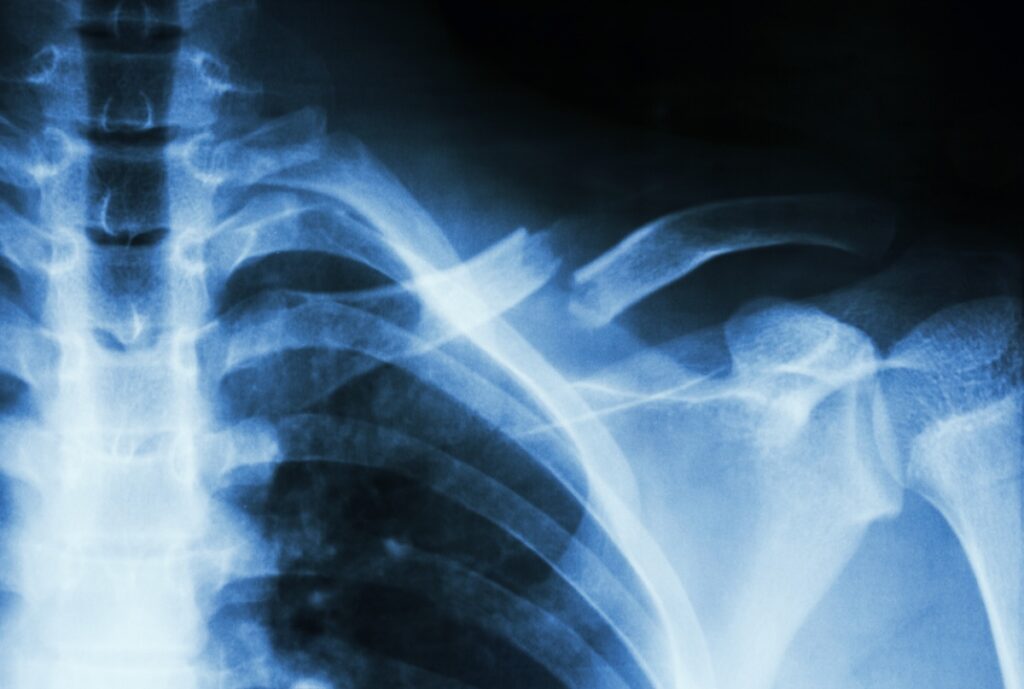
Clavicle fractures are a common orthopedic injury, accounting for approximately 2-5% of all adult fractures. Most fractures can be successfully managed nonoperatively with sling immobilization, analgesia, and progressive rehabilitation. However, certain characteristics of clavicle fracture and patient factors increase the risk of nonunion, malunion, or functional impairment and may favor surgical management.
The most widely accepted indications for operative treatment are open fractures, threatened skin, neurovascular injury, and symptomatic nonunion or malunion. Open fractures require urgent surgical irrigation and debridement with stabilization when appropriate. Similarly, significant skin tenting or compromise over a displaced fracture may indicate imminent skin breakdown and is generally considered an indication for surgery. Associated vascular or neurologic injury may also require operative management.
For displaced midshaft fractures, the decision is more nuanced. Historically, most were treated conservatively, but randomized trials and meta-analyses have demonstrated that plate fixation can improve union rates and reduce symptomatic malunion in appropriately selected patients. The benefit is most apparent in fractures with substantial displacement or shortening. Commonly cited relative indications include >2 cm of shortening, complete displacement, significant multiple fracture, or marked fracture displacement. However, shortening alone should not automatically mandate surgery, and thresholds vary among orthopedic surgeons and studies.
Surgical management of clavicle fracture may be particularly beneficial inactive adults, athletes, manual laborers, or patients who require rapid return to function. Plate fixation generally provides more predictable alignment and may facilitate earlier shoulder motion. For patients who heavily depend on shoulder function in their daily life, the potential functional consequences of persistent shortening, weakness, or symptomatic malunion may therefore weigh more heavily in the treatment decision.
Distal-third clavicle fractures are another important group of indications for surgical management. Fractures involving the coracoclavicular ligament complex, particularly unstable Neer type II and V patterns, have relatively high rates of nonunion with nonoperative treatment. Surgical fixation is therefore commonly considered for significantly displaced or unstable distal clavicle fractures, particularly in younger or active patients.
In contrast, minimally displaced fractures with an intact soft-tissue envelope and stable fracture pattern are generally treated nonoperatively. Older patients or those who only require lesser function may also conservative management when expected benefit of surgery is small relative to surgical risks.
The risks of operative treatment should be considered carefully. Potential complications include include infection, hardware irritation, neurovascular injury, nonunion, refracture after hardware removal, and the potential need for subsequent implant removal. Plate prominence is particularly common because of the clavicle’s subcutaneous location. Intramedullary fixation can reduce some soft-tissue irritation but has its own technical considerations and is not appropriate for every fracture pattern.
Overall, the decision to operate on a clavicle fracture should be individualized. Absolute indications include open fracture, threated skin, neurovascular compromise, and symptomatic nonunion or malunion. Relative indications include substantially displaced or shortened midshaft fractures, unstable distal-third fractures, significant comminution, and high functional demands. Patient age, occupation, athletic goals, comorbidities, fracture morphology, and tolerance for surgical complications should all be incorporated into shared decision-making.
References
- Canadian Orthopaedic Trauma Society. Nonoperative treatment compared with plate fixation of displaced midshaft clavicular fractures. J Bone Joint Surg Am. 2007;89(1):1-10. 10.2106/JBJS.F.00020
- Robinson CM, Goudie EB, Murray IR, et al. Open reduction and plate fixation versus nonoperative treatment for displaced midshaft clavicular fractures: a multicenter, randomized, controlled trial. J Bone Joint Surg Am. 2013;95(17):1576-1584. 10.2106/JBJS.L.00307
- Woltz S, Stegeman SA, Krijnen P, et al. Plate fixation compared with nonoperative treatment for displaced midshaft clavicular fractures: a multicenter randomized controlled trial. J Bone Joint Surg Am. 2017;99(2):105-112. 10.2106/JBJS.15.01394
- van der Meijden OA, Gaskill TR, Millett PJ. Treatment of clavicle fractures: current concepts review. J Shoulder Elbow Surg. 2012;21(3):423-429. 10.1016/j.jse.2011.08.053